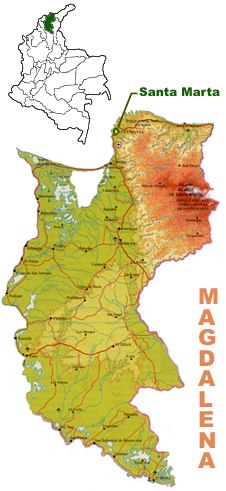
The department of Magdalena is located in the north
of Colombia and bordered by the Caribbean Sea and by the departments of
Bolívar, Atlántico, Cesar and La Guajira.
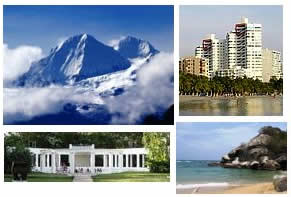
In Magdalena, you will find the majestic Sierra Nevada (a snow-covered
Mountain), the Sierra Nevada National Park, Santa Marta's
Cienaga Grande flora and fauna sanctuary and the Island of
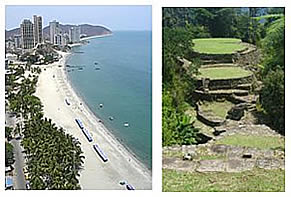
Salamanca. Deep in the jungle, there is "La Ciudad Perdida"
(the “Lost City”), which was discovered in 1975, an ancient city of the
Tayrona tribe, It is the 20 th century's largest archaeological find in
the Americas. The famous Bahía Concha and Cañaveral
beaches are also located in this department.
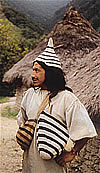
Before the arrival of the Spaniards, the land was populated by the
native Tayrona tribes. Alonso de Ojeda was the first Spaniard to step
onto Magdalena's territory. Twenty-six years later, Rodrigo de Bastidas
founded the city of Santa Marta, the central city of Santa Marta
province. In 1857, the region was named State of Magdalena and it became
a department in 1886.
Due to its large geographical size (23,188 square kilometers), its
economic sources are diverse: agriculture (African palm, rice, sorghum,
corn, cotton, coffee and banana crops as well as raising livestock),
livestoch and fishing in both the sea and river and mining (petroleum,
magnesium, calcareous and limestone).
Magdalena has about 1,410,000 inhabitants.
Capital: Santa Marta
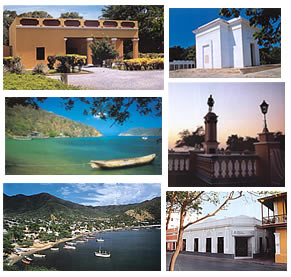
If you are looking for delight and beauty, Santa Marta has it all.
Beautiful beaches, ecological and historic places, hotels, nightlife and
happy and welcoming people.
The city's population is around 320,000 and it is one of the important
ports in Colombia.
Built at the foot of the impressive Sierra Nevada, Santa Marta attracts
thousands of tourists with different kinds of interests. Sun worshippers
and lovers of water sports, enthusiasts frequent the sandy beaches of
El Rodadero, history buffs visit museums like the
remarkable Quinta de San Pedro Alejandrino, where the Liberator
Simón Bolívar died. Archaeologists travel through the Lost
City and the
Pueblito and nature lovers are delighted with
their wonderful parks, where they join other visitors seeking
peacefulness and rest in this small but captivating city.

 Español
 Français