|
|
|
|
|
|
SUCRE
Inhabitant: Sucreño
Sucre is a place where Mother Nature has furnished everything. The
department is known for its extensive mangrove swamps, coralliferous
islands and coconut palms.
This immense valley, with a surface of 10,917 square kilometres and an
average temperature of 27 degrees Celsius, is bordered by the
departments of Bolívar and Cordoba and by the Caribbean Sea.
The territory was part of Bolívar until 1966, when Sucre's
territory separated from its neighbouring department and became a
department in its own right. The region was inhabited by the native
Finizenú, Zenufana and Panzenú of the Caribbean linguistic
family. At present, there are about 900,000 people in Sucre. The
Sucreños, who are festive and vigorous people, are called
“coastal Sabaneros”.
Livestock breeding is Sucre's most economic activity and poultry farming
has seen a boom in recent years. Yucca, rice, sesame and yam are the
main agricultural crops in Sucre, which is Colombia's biggest yam
producer.
Miles and miles of beautiful beaches in the Gulf of Morrosquillo, like
those of Tolú and Coveñas, bring many tourists to this
department. Most visitors also come to enjoy the Orchestra Festival, the
Sabanero Accordion Festival, the traditional corralejas and the
livestock fair.
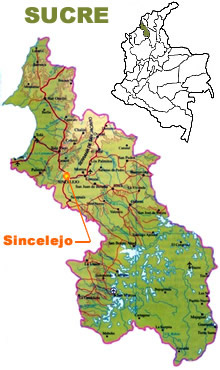
Capital: Sincelejo
Also known as the “pearl of the savannah” and “the cebuista
capital of Colombia” (from the cebú cattle
raisers),
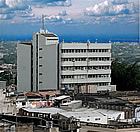
Sincelejo is a modern city with about 290,000 people. It is believed
that its founder was Francisco Sincelejo so bears his name. Others
believe the name has a native origin. When it was founded in 1535, it
received the name of Francisco de Asís Sincelejo.
Agriculture turned this prosperous city into one of the most dynamic and
quickly developing zones in the region.
Every year, the Sincelejo inhabitants celebrate their traditional
corralejas on January 20. The corralejas were
cancelled in 1980 becacuse of a terrible tragedy. They resumed in 1999
under the supervision of local authorities.
|
| |
 The Flag of
the Department
of Sucre
|
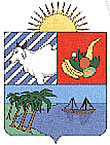
The Emblem of
the Department
|
|
Outstanding People Born in Sucre
>> Writers and Poets
>>Artists
>> Actors (in Spanish)
>> Musicians
>> Sportsmen
>> Beauty Queens |
Music
To listen to the songs from this region,
click on the speaker below .
www.colombia-sa.com
Música del departamento
|
|
|
|
|
Anthem of the Department of Sucre
(In Spanish)
Author: Fortunato Chadid
Patria colombiana
es mi Sucre lo más lindo de mi suelo
donde se prolonga el cielo
en las aguas del hermoso mar azul.
Sucre es un tesoro de belleza sin igual,
sus verdes montañas, sus arroyos y su mar
sucre tiene un paraíso, en el hechizo
de sus praderas;
es mi tierra toda entera
un gran jardín primaveral.
Sucreño soy de corazón
mi bandera verde y blanco es alegría,
soy amante de la paz y la armonía,
el progreso, la justicia y la razón.
Sucre la gran fertilidad
de sus campos te brinda su riqueza,
tus cultivos y dehesas
son patrimonio nacional
tus cultivos y dehesas
son patrimonio nacional.
|
|
Other Municipalities
Corozal, San Marcos, Tolú, Sincé, Sucre, San Onofre,
Sampués, Coveñas.
Airports
Las Brujas – Corozal
Coveñas –
Coveñas
Tolú – Tolú
Annual Events
January: The Corralejas Festivals (Sincelejo) –
Sirenato of the Sea (Tolú).
August: Presentation of National Bands (Sincelejo).
October: National
Festival of Bagpipes (Ovejas).
December: Festival of the Sombrero Vueltiao
(Sampués).
Google Ads
(Cont.) Anthem
Patria colombiana
es mi Sucre lo más lindo de mi suelo
donde se prolonga el cielo
en las aguas del hermoso mar azul.
Sucre es un tesoro de belleza sin igual,
sus verdes montañas, sus arroyos y su mar
Sucre tiene un paraíso, en el hechizo
de sus praderas;
es mi tierra toda entera
un gran jardín primaveral.
Sucre, glorioso Mariscal,
esta tierra es monumento a tu memoria,
con orgullo mirarás desde la historia,
nuestro suelo que tu nombre lleva ya.
Sucre, tu pueblo seguirá
en la paz tu camino de grandeza
y seremos con nobleza
un gran ejemplo nacional,
y seremos con nobleza
un gran ejemplo nacional.
|
| |
|
Google
Ads

|
 Español
 Français