 SANTANDER
Inhabitant: Santandereano
SANTANDER
Inhabitant: Santandereano
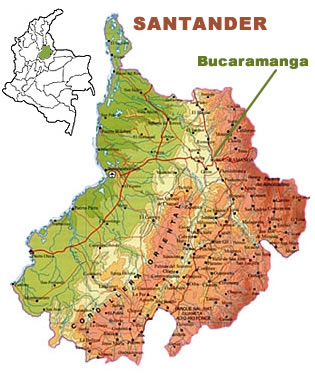
One of the most important regios of Colombia is the department (state)
of Santander. It lies in the north-eastern of Colombia and borders the
departments of Norte de Santander, Boyacá, Antioquia,
Bolívar and Cesar. Its area is 30,537 square kilometres. It has
around 2,087,000 inhabitants.
Its land is divided into two large geographical regions. On the western
lies the Magdalena River valley. It is a mostly flat area with an
average temperature of 29 degrees Celsius. The eastern side is home to
the mountainous region of the eastern
cordillera (mountain
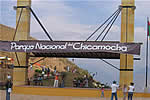
range) where the spectacular Cañon del Chicamocha is located. It
is one of the most important tourist places in the department, along
with the flora and fauna sanctuary Guanentá and the Afrodita
waterfall, located near the town of San Gil.
The economy is based on agriculture, but it is quickly being surpassed
by industries like cement production, textiles, processed food and
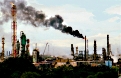
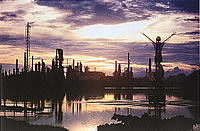
metallurgy. Barrancabermeja's oil refinery is the most important one in
Colombia and one of the best in Latin America.
The department also has an excellent communications system. The
Magdalena River is used to transport most of their products all over the
country.
Santander and Norte de Santander formed the Sovereign State of
Santander. This state became a department in 1886 but was separated into
two different political units (Santander and Norte de Santander) in
1909.
Before the discovery of the Americas, native tribes such as the Guanes,
Yariguíes and Opones inhabited the region.
The conquest began in 1529 with the arrival of the Spanish conquistador
Antonio of Lebrija, followed by Ambrosio Alfinger, Jiménez de
Quesada and Martin Galeano. Santander has had a great quantity of
European immigrants through the years, mainly from Spain and Germany.
Capital: Bucaramanga
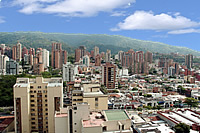
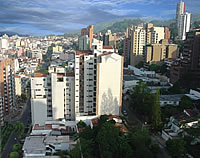
The picturesque and welcoming city of Bucaramanga is situated in the
Valley of Río de Oro (Golden River). It covers an area of 165
square kilometres and its average temperature is about 28 degrees
Celsius.
It was founded in 1622 by Andrés Trujillo and Andrés
Páez of Sotomayor. It is believed that its name comes from the
native words
bucar (lord) and
amanga (home ground).
The urban centre has all the advantages and infrastructure of a big city
while keeping the charm of a small one. Nearly one million people live
in this town.
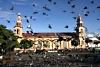
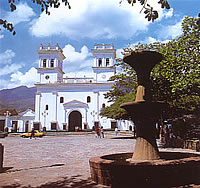
Bucaramanga is known as the “city of parks” for its numerous green
belts, which are kept as large gardens full of flowers and trees. One of
them is the beautiful Garcia Rovira Park, located in the center of the
city.
Bucaramanga has important museums such as the Museum of Natural History
and Geology and the Fine Arts Museum, prestigious art centers,
universities and educational institutions, industrial and commercial
centers and a great variety of recreational places.
 SANTANDER, C0L0MBIA - SOUTH
AMERICA
SANTANDER, C0L0MBIA - SOUTH
AMERICA Español
 Français