|
|
|
|
|
|
VALLE DEL CAUCA
Inhabitants: Vallecaucanos
Valle del Cauca, a region of exceptional beauty and
plentiful resources, is one of the most captivating places in the
country.
Its spectacular landscapes, the diversity of its climates, the richness
of its soil, its wonderful rivers and forests as well as its booming
cities, make of this department a fascinating place.
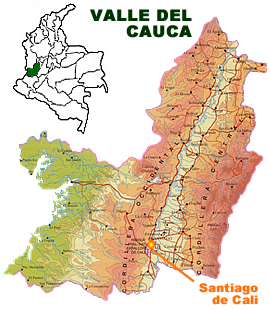
It lies in western Colombia and its surface covers an area of 22,140
square kilometres. Nearly four and a half million people live there.
This department borders Chocó, Quindío, Risaralda, Tolima,
Cauca and the Pacific Ocean. Its creation dates back to 1910.
The land area has many different topographical features: the plain of
the Pacific, the zone of the western Andean cordillera (mountain range),
the western slope of the Central Andean cordillera and the inter-Andean
Cauca river valley, a very fertile area where agriculture is the most
important sector of the economy.
Valle del Cauca is Colombia's largest sugar-cane producer. It also
has large rice fields and grows sorghum, yucca, coffee, cocoa, cotton,
corn and bean crops. The livestock industry is based on bovine, ovine,
pork and equine breeding.
The territory is also rich in coal, limestone, marble, gold, silver,
platinum, iron and asbestos. The department ranks third among other
Colombian departments for industrial development.
The Vallecaucanos are the descendants of diverse racial groups who
have been intermarrying throughout many generations. Many centuries ago,
various native groups such as the Lilíes and the Gorrones lived
in this region. Then, the Spaniards arrived and brought Africans as
their slaves. Later, large groups from different European countries
arrived and at the beginning of the 20th century there was a large
influx of Japanese people.
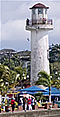
Buenaventura, a port city on the Pacific Ocean, is the most important
sea port of the country, due to the immense amount of import and export
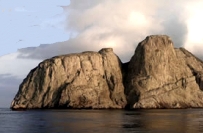
cargo traffic. Near Buenaventura, the archipelago of Malpelo is found.
This is a marvellous place (a natural world heritage) visited by many
tourists due to its biodiversity and coral formations.
Capital:
Santiago de Cali
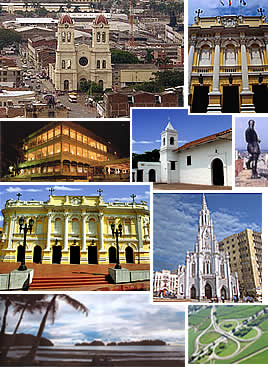
This cosmopolitan city, renown both nationally and internationally, is
known as The Sultaness of the Valley. It has nearly three
million residents and was founded by Sebastian of Belalcazar in 1536.
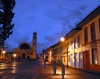
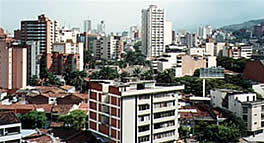
Cali has an excellent urban infrastructure. There are many skyscrapers,
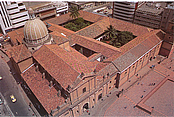
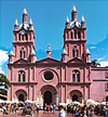
elegant residences, colonial-style houses and churches, parks, museums,
art galleries, theatres, hotels and beautiful parks .
Some locations of interest include the famous Plaza de Caicedo, the
Church of the Ermita, the monument to the city's founder
Sebastián de Belalcázar and the large monument to Cristo
Rey situated at the top of Los Cristales hill. The zoological park is
one of the best in the country.
The historical site El Paraíso estate (ranch) is found close to
the city and was the setting for the novel María, written by the
famous Jorge Isaacs. Today, this place is a museum. Cali is also the
capital of salsa and rumba and is known for its intensive nightlife.
|
 Español
 Français